


The Science Behind a Memorable Mind
By: Nissara Shah

You can spend hours studying, only to discover that the information has completely vanished from your mind by the next day. Meanwhile, information you barely noticed can remain vivid for years.
Memory is far more than the brain simply storing information. It is a process that constantly filters, strengthens, and reshapes what we experience.
Let’s take a closer look at the science that shapes what the brain preserves and what it erases!
How Memories Are Formed
Memory is the brain’s ability to encode, store, and retrieve information over time, allowing us to retain and use what we learn and experience. It begins with encoding, the process of transforming incoming information into a form the brain can use and store. Information can be encoded visually through images, acoustically through sounds, or semantically through meaning. The hippocampus plays an important role in forming and organizing new memories. Once encoded, information moves into storage, where changes in connections between neurons help store memories over time. These memories are distributed across the cerebral cortex, where different regions contribute to different aspects of what we have experienced. The final stage, retrieval, is the process of accessing stored information and bringing it back into conscious awareness. This hippocampus helps locate memories by activating the neural patterns associated with them. Overall, encoding, storage, and retrieval form the foundation of memory, turning experiences into memories that can be retained and recalled.
The Different Types of Memory
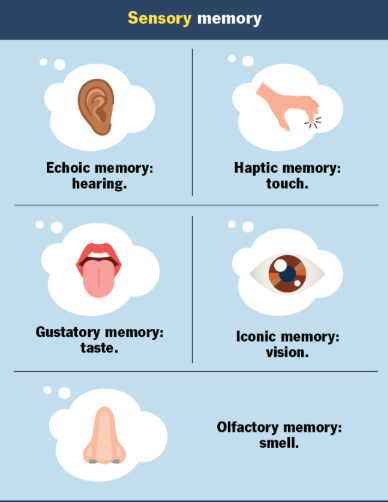
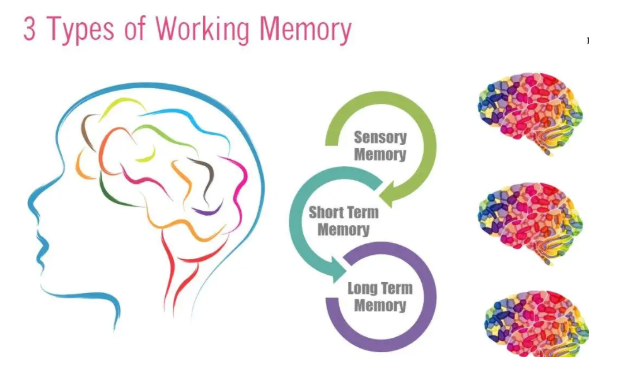
Memory is not one single system. The brain uses different types of memory to briefly hold information, actively work with it, and retain it over longer periods of time. Sensory memory briefly holds information from our senses such as sights, sounds, and touch before it either faces or receives attention. Short-term memory temporarily stores a limited amount of information for a short period of time before it is forgotten or transferred for further processing. Working memory temporarily holds and manipulates information allowing us to solve problems, make decisions, and complete tasks. Long-term memory stores information for extended periods of time and has a much greater capacity than short-term memory. Explicit memory involves consciously recalling facts and experiences, while Implicit memory influences skills, habits, and behaviors without conscious recall.
Why We Forget
Forgetting is the brain’s natural process of losing access to information that was previously learned or experienced. Information can become harder to retrieve over time when it is not revisited, as the neural connections involved in a memory may weaken and become less active. Retrieval failure occurs when a memory has been stored but the brain cannot successfully reactivate the neural pattern associated with it. Interference occurs when memories compete with one another, making it more difficult for the brain to retrieve specific information. Proactive interference occurs when older memories interfere with the formation or retrieval of newer information, while retroactive interference occurs when newly learned information disrupts the retrieval of older memories. Changes in synaptic strength, which refers to the strength of connections between neurons, can also affect how easily memories are maintained or retrieved.
Why Some Memories Last
Some memories last longer than others because certain experiences create stronger connections between neurons in the brain. Emotion can strengthen memory by increasing activity in the amygdala, a brain region involved in processing emotional experiences, which can influence how strongly an event is encoded and stored. Repetition reinforces memories by repeatedly activating the same neural pathways, making the connection between neurons more efficient and the information easier to retrieve. Attention affects memory because focusing on information increases the likelihood that it will be encoded into long-term memory. Elaborative encoding, which involves connecting new information to existing knowledge, experiences, or meaningful details, creates multiple associations that can make a memory easier to retrieve. Memory consolidation, the process of strengthening newly formed memories, occurs over time as the brain reorganizes and reinforces the neural connections involved in learning. Sleep also supports this process by replaying patterns of neural activity associated with recently learned information, helping the brain reinforce and store these memories for the long term.
Why Memories Change
Memories can change each time they are recalled because the brain can modify stored information. Reconsolidation is the process in which retrieved memory becomes temporarily flexible before being stored again, allowing new information or details to become connected to it. Memory distortion occurs when inaccurate information, emotions, or later experiences alter how an event is remembered.
By understanding the science behind memory, we can learn more effectively, strengthen our recall, and make the most of the brain;s ability to remember.

Citations
Image 1: https://www.hopkinsmedicine.org/health/wellness-and-prevention/inside-the-science-of-memory
Image 3: https://my.clevelandclinic.org/health/articles/memory
Image 4: https://www.everydayhealth.com/brain-health/types-of-memory-short-long-working-memory-and-more/
How memories are formed: https://www.sciencedirect.com/topics/social-sciences/memory-encoding
The different types of memory: https://my.clevelandclinic.org/health/articles/memory
Why do we forget: https://pmc.ncbi.nlm.nih.gov/articles/PMC5657245/
Why memories last: https://www.ncbi.nlm.nih.gov/books/NBK231619/
Why memories change: https://memoryperformancelab.com/memory-reconsolidation/


Comments